



Best CBG Gummies in Europe (2026): Focus, Calm & Balance


CBG gummies are growing fast across Europe. More people now choose them for daytime focus, calm, and mental balance — without intoxication. But with more products on the market, it gets harder to know which ones are actually worth buying.
In this guide, we break down the best CBG gummies in Europe for 2026. We cover what to look for, how CBG differs from CBD, and which products from Canna Health Amsterdam stand out this year.
Note: CBG gummies are not medicines. They are not intended to diagnose, treat, cure, or prevent any condition. Individual responses vary. Always consult a healthcare professional if you have health concerns.
What Is CBG and Why Do People Choose It?
CBG stands for cannabigerol. It is the precursor cannabinoid — the plant uses it to make CBD and THC as it matures. Because of this, mature hemp plants contain only small amounts of CBG. So CBG products are less common and often more premium than CBD.
Unlike THC, CBG does not produce a high. So people use it during the day without worrying about intoxication. In contrast to some CBD products, which many people associate with relaxation and winding down, CBG attracts users who want something clear and functional.
Research into CBG is still developing. However, early studies and user surveys suggest that people choose CBG gummies most often for focus support, stress management, and daily mental balance. These are user-reported experiences, not clinical claims.
How We Pick the Best CBG Gummies
We apply the same criteria to every product we stock and recommend at Canna Health Amsterdam. So here is exactly what we check:
- CBG dose per gummy. We only list products that clearly state the exact CBG milligrams per gummy — not just total cannabinoid content.
- Third-party lab testing. Every product must have a published Certificate of Analysis (COA) from an independent lab. This confirms cannabinoid levels and rules out contaminants.
- EU THC compliance. All products must stay below 0.2% THC — the legal limit in most EU countries, including the Netherlands.
- Ingredient transparency. Full ingredient lists must be available. If a product includes additional active ingredients, the exact amounts must be on the label.
- Vegan and clean formula. We prioritise products that are vegan, gluten-free, and free from unnecessary fillers.
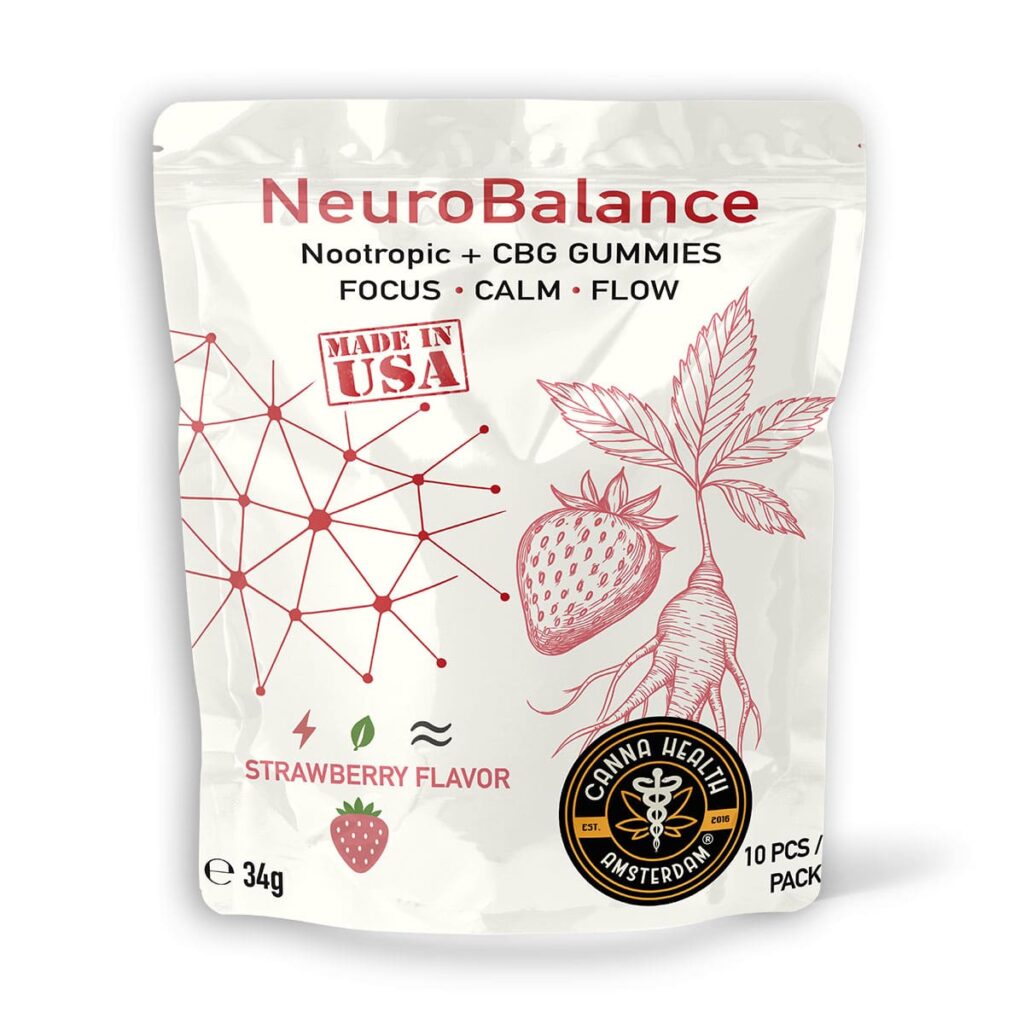
1. NeuroBalance Focus CBG Gummies — Strawberry
The NeuroBalance Focus CBG Strawberry gummy is our top pick for daytime focus support. Each gummy delivers 25 mg of CBG alongside a targeted nootropic blend. Because of this combination, it stands out from plain CBG gummies that contain no additional active ingredients.
Active ingredients per gummy:
- Cannabigerol (CBG) — 25 mg
- Bacopa extract — 25 mg
- Ginkgo biloba extract — 50 mg
- Alpha GPC — included in nootropic blend
- Zinc & Vitamin B5 — included in nootropic blend
Format: Vegan. Gluten-free. 25 mg CBG per gummy. Independent COA available on the product page.
Best for: People who want a functional daytime gummy with both CBG and nootropic support in a single product.
Flavour: Strawberry.
👉 View product:
NeuroBalance Strawberry CBG Gummies
2. NeuroBalance Focus CBG Gummies — Mixed Berries
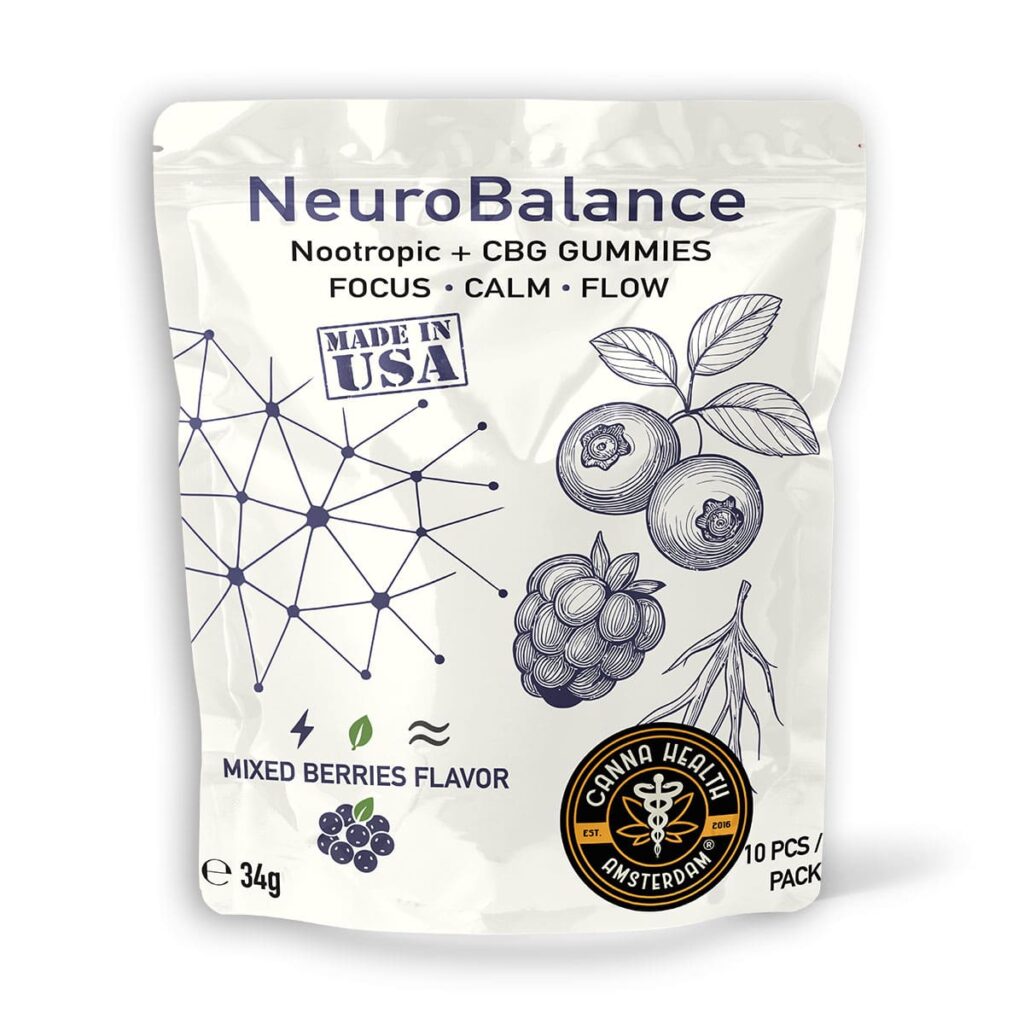
The NeuroBalance Focus CBG Mixed Berries gummy uses the same formula as the Strawberry version. So if you want the same functional profile with a different flavour, this is the straightforward choice.
Active ingredients per gummy:
- Cannabigerol (CBG) — 25 mg
- Bacopa extract — 25 mg
- Ginkgo biloba extract — 50 mg
- Alpha GPC — included in nootropic blend
- Zinc & Vitamin B5 — included in nootropic blend
Format: Vegan. Gluten-free. 25 mg CBG per gummy. Independent COA available on the product page.
Best for: People who prefer a berry flavour profile but want the same consistent NeuroBalance Focus formula.
Flavour: Mixed berries.
👉 View product:
NeuroBalance Mixed Berries CBG Gummies
NeuroBalance Strawberry vs Mixed Berries: Which One?
Both products use the same CBG and nootropic formula. So the choice comes down entirely to flavour preference. Here is a quick comparison:
- Same CBG dose: 25 mg CBG per gummy in both versions.
- Same nootropic blend: Bacopa, Ginkgo biloba, Alpha GPC, Zinc, Vitamin B5 in both.
- Same compliance: Both are EU THC-compliant, vegan, and gluten-free.
- Only difference: Flavour — Strawberry vs Mixed Berries.
In short, if you already know you prefer one flavour, go with that. If you are trying CBG gummies for the first time, either option gives you the same experience.
CBG Gummies vs CBD Gummies: What’s the Difference?
This is one of the most common questions we get. So here is a clear answer.
Both CBD and CBG are non-intoxicating cannabinoids from the hemp plant. However, they have different molecular shapes and interact with the body’s systems in different ways. Because of this, people often report different experiences from each one.
CBD gummies are more widely available and generally less expensive. Many people use them in the evening or for general daily wellness. CBG gummies, on the other hand, tend to attract users who specifically want a daytime option that feels clear and alert-friendly rather than relaxing.
Some products — including full-spectrum CBD oils — contain both cannabinoids together. But if you want a focused CBG dose with a known amount per gummy, a dedicated CBG gummy is the better choice.
Neither CBD nor CBG gummies are medicines. However, they are different products with different profiles. So it is worth understanding what you are buying before you choose.
When Do People Use CBG Gummies?
Because CBG gummies are non-intoxicating, many people fit them into a morning or daytime routine. Common moments people choose include:
- Before a long work session or study block
- During a stressful period when mental load is high
- As a caffeine-free option on days when stimulants feel like too much
- As a consistent daily supplement taken at the same time each day
Like many supplements, CBG may take a few weeks of consistent use before you notice a clear pattern. So starting with one gummy per day and tracking how you feel over two to three weeks is a sensible approach.
Are CBG Gummies Legal in Europe?
Yes — in most European countries, CBG gummies are legal when producers make them from hemp and keep THC at or below 0.2%. CBG is non-intoxicating and does not fall under controlled substance rules in most EU markets.
All NeuroBalance Focus CBG Gummies sold by Canna Health Amsterdam comply with Dutch and EU legal requirements. Independent COAs confirm THC levels on every product page. However, laws do vary across EU countries. So always check the rules in your specific location before ordering.
Final Verdict
If you are looking for the best CBG gummies in Europe in 2026, the NeuroBalance Focus range from Canna Health Amsterdam is the strongest option currently available. Both variants — Strawberry and Mixed Berries — deliver 25 mg of CBG per gummy alongside a full nootropic blend, with independent lab testing and clear EU compliance.
The choice between the two comes down to flavour. Everything else is identical. So pick your preferred taste, check the COA on the product page, and start with one gummy per day to find the dose that works for you.
References
- Nachnani R, et al. (2021). The pharmacological case for cannabigerol. Journal of Pharmacology and Experimental Therapeutics, 376(2), 204–212. Journal ↗
- Patel M, et al. (2021). Survey of patients employing cannabigerol-predominant cannabis preparations. Cannabis and Cannabinoid Research, 7(5), 706–716. Journal ↗
- Stough C, et al. (2001). The chronic effects of an extract of Bacopa monniera on cognitive function in healthy human subjects. Psychopharmacology, 156(4), 481–484. Journal ↗
- Tan MS, et al. (2015). Efficacy and adverse effects of Ginkgo biloba for cognitive impairment and dementia: a systematic review and meta-analysis. Journal of Alzheimer’s Disease, 43(2), 589–603. [Cited for Ginkgo biloba ingredient context only — not as a claim about CBG gummies.] Journal ↗
- European Industrial Hemp Association (EIHA). (2023). Hemp regulatory update: THC limits across EU member states. Source ↗
Frequently Asked Questions: Best CBG Gummies in Europe
What are the best CBG gummies in Europe in 2026?
The NeuroBalance Focus CBG Gummies from Canna Health Amsterdam are among the strongest options available in Europe in 2026. Each gummy delivers 25 mg of CBG alongside a nootropic blend including Bacopa extract, Ginkgo biloba, Alpha GPC, Zinc, and Vitamin B5. Both the Strawberry and Mixed Berries variants are vegan, EU THC-compliant, and independently lab-tested. COAs are available on the product pages.
What is the difference between CBG gummies and CBD gummies?
Both CBG and CBD are non-intoxicating cannabinoids from hemp. However, they have different molecular structures and interact with the body in different ways. CBD gummies are more widely available and often used for general daily wellness. CBG gummies tend to attract users who want a clear, daytime-friendly option. People often describe CBG as feeling more alert and functional compared to CBD. Neither is a medicine or approved treatment.
How much CBG should a good gummy contain?
Most quality CBG gummies on the European market contain between 10 mg and 25 mg of CBG per gummy. The NeuroBalance Focus CBG Gummies contain 25 mg per gummy, which is at the higher end of what is currently available. If you are new to CBG, starting with one gummy per day and adjusting based on how you feel is a sensible approach. Always check that the label states the exact CBG milligrams per gummy — not just total cannabinoid content.
Are CBG gummies legal to buy in Europe?
Yes — CBG gummies are legal in most European countries when made from hemp and kept below the local THC limit, which is 0.2% in most EU member states. CBG is non-intoxicating and does not fall under controlled substance regulations in most EU markets. All NeuroBalance Focus CBG Gummies sold by Canna Health Amsterdam comply with Dutch and EU legal requirements. Always check local rules if you are ordering from outside the Netherlands.
Disclaimer: This blog is for informational and educational purposes only. We review and reference available studies and reputable sources; however, content may not reflect the most current research or regulations and should not be taken as medical, legal, or professional advice. We do not make or imply health claims. Products mentioned are not intended to diagnose, treat, cure, or prevent any disease and statements have not been evaluated by EFSA or the FDA. Effects can vary between individuals. Always consult a qualified healthcare professional before use and verify that any product or ingredient is lawful in your jurisdiction.