

Hemp in Ukraine and Russia: A History of the World’s Oldest Crop

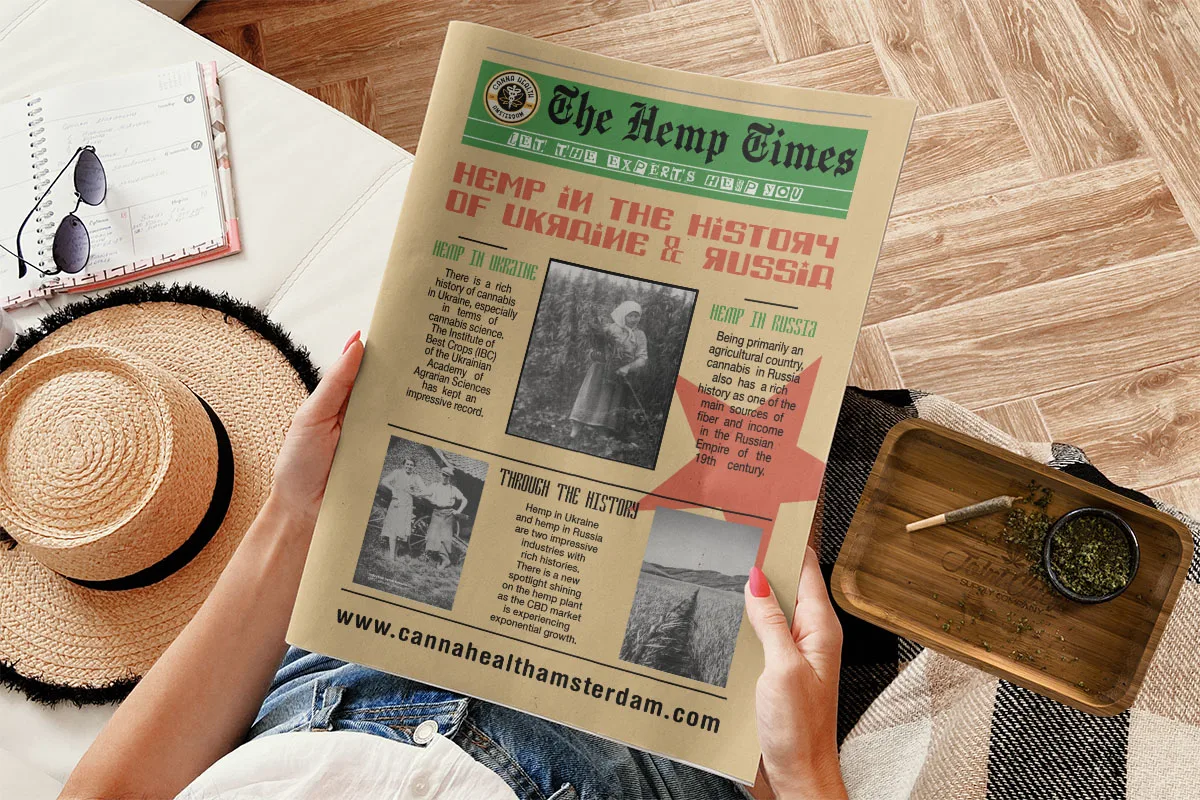
Hemp is one of the oldest cultivated plants in human history. Archaeological evidence places its cultivation as far back as 8,000 BC in parts of Asia. But few regions shaped the global hemp trade as significantly as Eastern Europe — and within Eastern Europe, Ukraine and Russia stand out as having particularly deep roots with this plant.
Before cotton dominated global fiber markets, hemp clothed armies, rigged sailing ships, and fed rural populations across the continent. Understanding hemp’s role in Ukrainian and Russian history means understanding a plant that was, for centuries, as economically important to this region as wheat or timber.
Hemp as One of Humanity’s Oldest Crops
Cannabis sativa — the plant species that includes both hemp and marijuana — has been cultivated by humans for thousands of years. Hemp refers specifically to varieties of Cannabis sativa grown for their fibre, seeds, and other non-intoxicating uses. Unlike marijuana, hemp contains minimal THC — the compound responsible for psychoactive effects — and correspondingly high levels of CBD and other cannabinoids.
Hemp’s utility is remarkable. The plant’s fibrous stalks produce some of the strongest natural fibres available — historically used for rope, sail canvas, clothing, and paper. Its seeds are nutritionally rich, containing complete protein, essential fatty acids, and minerals. Hemp has also served as a building material, animal feed, and — more recently — a source of cannabinoid extracts including CBD.
Consequently, wherever agriculture took hold across the temperate world, hemp often followed. Eastern Europe, with its fertile soils and continental climate, proved particularly well-suited to hemp cultivation. By the early modern period, the region had developed industrial-scale hemp production that served European markets for centuries.
Hemp in Ukraine: From Ancient Cultivation to Soviet Industry
Hemp cultivation in the territory of modern Ukraine stretches back millennia. Archaeological finds from Scythian burial sites — dating to the first millennium BC — include hemp seeds and equipment associated with hemp use. Greek historian Herodotus, writing in the 5th century BC, described Scythians using hemp in steam baths in the region north of the Black Sea.
By the medieval period, hemp was deeply embedded in Ukrainian agricultural life. Rural communities across the country grew hemp for domestic use — fibres for clothing and rope, seeds for oil and food. Hemp seed oil was a staple cooking fat in regions where olive oil was unavailable. Hemp cloth was the primary fabric for peasant clothing across much of the country.
Soviet Ukraine and Industrial Hemp Production
The industrial scale of Ukrainian hemp production reached its peak in the Soviet era. Before the 1950s, more than 150,000 hectares of Ukrainian land were dedicated to hemp cultivation. Soviet Ukraine was one of the largest hemp producers in the world. The plant supplied fibre for the Soviet textile industry, rope for the navy and military, and seed oil for food and industrial use.
The Institute of Bast Crops — based in Ukraine — became one of the most significant centres of hemp research in the world. Scientists there worked for decades on hemp agronomy: developing varieties suited to different soils and climates, improving fibre yields, and studying the plant’s biology systematically. The knowledge accumulated at this institution represents one of the most extensive bodies of hemp science assembled anywhere.
The decline came in the second half of the 20th century. Global cotton production expanded dramatically, particularly in Soviet Central Asia under the Khrushchev and Brezhnev-era agricultural programmes. Cotton replaced hemp as the primary textile fibre across much of the Soviet Union. Hemp acreage in Ukraine fell sharply from the 1960s onwards as state priorities shifted.
Hemp’s Revival in Modern Ukraine
Ukraine has experienced a genuine hemp revival since the early 2000s, accelerating significantly alongside the global growth of the CBD market. The country’s agricultural conditions — fertile black soil, experienced farming infrastructure, and established hemp research institutions — position it as a natural supplier for the European hemp industry.
Industrial hemp cultivation became legally established in Ukraine with licensing requirements administered through the State Service on Medicines and Drugs Control. Ukrainian hemp exports — particularly hemp seed, hemp fibre, and CBD extracts — have grown significantly. Several European CBD brands source raw material from Ukrainian producers, building on the country’s deep agricultural heritage with the plant.
Hemp in Russia: The Empire’s Most Valuable Fibre Crop
Russia’s relationship with hemp is, if anything, even more historically significant than Ukraine’s in terms of its impact on global trade. For several centuries, Russian hemp was not merely a domestic commodity — it was one of the Russian Empire’s most important exports and a critical strategic resource for European naval powers.
The Hemp Trade and European Naval Power
Hemp rope and hemp canvas were the backbone of sailing-ship technology. Every major European naval vessel — British, Dutch, French, Spanish — required enormous quantities of hemp for its rigging, sails, and caulking. A single ship-of-the-line required tens of tonnes of hemp products. The ability to supply this demand was consequently a matter of strategic importance.
Russia, with its vast agricultural territories and ideal growing conditions across the central and southern regions, dominated this supply. The Brockhaus and Efron Encyclopedic Dictionary — the major reference work of the Russian Empire — recorded that by the end of the 19th century, Russia accounted for approximately 40% of total European hemp production. The primary growing regions were in central Russia, particularly around Kursk, Orel, and the Chernozem belt.
The geopolitical importance of Russian hemp is reflected in historical diplomacy. Napoleon’s Continental System — his attempt to blockade Britain economically — was in part undermined by Russia’s continued hemp trade with Britain. British naval supremacy depended on Russian hemp, and this dependency shaped the alliance politics of the Napoleonic era. Russia’s decision to continue supplying Britain despite French pressure was a significant factor in the deterioration of the Franco-Russian alliance that led to the 1812 invasion.
The Decline of Russian Hemp Production
Russian hemp production declined through the 20th century for the same interconnected reasons that affected hemp globally. The rise of synthetic fibres — nylon, polyester — from the 1940s onwards eliminated much of the industrial demand for natural fibre. Cotton expansion across Soviet Central Asia, heavily promoted as a strategic crop, displaced hemp in state agricultural planning. Anti-cannabis legislation in various forms contributed to further decline.
Russia retains some industrial hemp cultivation today. Licensed cultivation of varieties containing no more than 0.1% THC, registered in the State Register of Plant Varieties, has continued in certain agricultural regions. However, the scale bears no comparison to the empire-era dominance that once made Russian hemp a keystone of European commerce.
Hemp’s Historical Legacy and the Modern CBD Market
The current global interest in hemp-derived CBD products represents the latest chapter in a cultivation history that stretches back thousands of years. Eastern Europe’s deep agricultural relationship with hemp — the research institutions, the farming knowledge, the established supply chains — gives the region a structural advantage in the modern hemp industry that is directly rooted in its history.
Ukraine in particular has re-emerged as a significant supplier of hemp biomass and CBD extract to European markets. The same fertile soils and agricultural infrastructure that supported Soviet-era hemp production now supply hemp raw material to CBD brands across the continent. History, in this case, is genuinely relevant to where the hemp in a European CBD product may have come from.
Conclusion
Hemp’s role in the history of Ukraine and Russia is not a footnote — it is a central thread. From Scythian burial sites to Soviet industrial agriculture, from Napoleonic naval strategy to modern CBD extraction, this plant has shaped the economies and daily lives of millions of people across the region over thousands of years.
The current revival of hemp cultivation — particularly in Ukraine — connects directly to this heritage. The knowledge, the infrastructure, and the agricultural culture built over centuries did not disappear during the decades of decline. It is now finding new relevance in a global market that has rediscovered what Eastern European farmers understood long ago: hemp is an extraordinarily useful plant.
References
- Herodotus. Histories, Book IV (c. 440 BC). [Primary source for Scythian hemp use in Eastern Europe]
- Brockhaus FA, Efron IA, eds. (1890–1907). Entsiklopedicheskiy slovar [Encyclopedic Dictionary]. St. Petersburg. [Source for Russian Empire hemp production statistics — approximately 40% of European production by end of 19th century]
- Clarke RC, Merlin MD. (2013). Cannabis: Evolution and Ethnobotany. University of California Press. [Comprehensive botanical and historical reference for hemp cultivation globally]
- Small E. (2015). Evolution and classification of Cannabis sativa (marijuana, hemp) in relation to human exploitation. Botanical Journal of the Linnean Society, 179(4), 427–452. Journal ↗
Frequently Asked Questions About Hemp History in Ukraine and Russia
Why was hemp so important to Eastern Europe historically?
Hemp was one of the most economically valuable crops available before synthetic fibres and industrial cotton. Its fibres produced rope, canvas, and clothing. Its seeds provided oil and food. The climate and soil conditions across Ukraine and Russia were exceptionally well suited to hemp cultivation, making the region a dominant global supplier. At peak production in the 19th century, Russia alone accounted for approximately 40% of European hemp output — primarily supplying fibre for naval rigging and sail canvas.
What role did Russian hemp play in the Napoleonic Wars?
British naval supremacy depended heavily on Russian hemp for rope and canvas. Napoleon’s Continental System attempted to cut Britain off from this supply. Russia’s decision to continue trading with Britain, partly driven by the economic importance of the hemp trade, contributed to the breakdown of the Franco-Russian alliance. This deterioration was a significant factor in Napoleon’s decision to invade Russia in 1812. The hemp trade was therefore not just an agricultural footnote — it influenced the course of one of history’s most consequential military campaigns.
How much hemp did Soviet Ukraine produce?
Before the 1950s, Soviet Ukraine dedicated more than 150,000 hectares to hemp cultivation — making it one of the largest hemp-producing regions in the world. Production declined significantly from the 1960s onwards as cotton expansion in Soviet Central Asia shifted state agricultural priorities. The Institute of Bast Crops in Ukraine had by that point accumulated one of the most extensive bodies of hemp agronomic research in existence, which remains a significant scientific legacy.
Is Ukraine still an important hemp producer today?
Yes. Ukraine has re-emerged as a significant hemp producer since the early 2000s and has grown considerably alongside the European CBD market. The country’s fertile black soil, established agricultural infrastructure, and historic hemp research institutions give it structural advantages. Ukrainian hemp seed, fibre, and CBD extracts are exported to European markets. Several European CBD brands source raw material from Ukrainian producers.
Disclaimer: This blog is for informational and educational purposes only. We review and reference available studies and reputable sources; however, content may not reflect the most current research or regulations and should not be taken as medical, legal, or professional advice. We do not make or imply health claims. Products mentioned are not intended to diagnose, treat, cure, or prevent any disease and statements have not been evaluated by EFSA or the FDA. Effects can vary between individuals. Always consult a qualified healthcare professional before use and verify that any product or ingredient is lawful in your jurisdiction.